Edgar Payne (1883–1947): Biography and Collector's Guide
Edgar Alwin Payne was one of the defining painters of the American West and of California Impressionism: the painter of the High Sierra, the Navajo country, the Laguna coast and the fishing fleets of Brittany. This guide covers his life and work, and what collectors and owners should know about buying, selling and authenticating his paintings.
Early life and self-education
Edgar Payne was born on March 1, 1883, in Washburn, in Barry County in the Ozark country of southwestern Missouri. He left home as a teenager and spent his early working years on the move, earning a living as a house painter, sign painter and painter of theatrical scenery while he travelled through the South and Midwest. That practical training mattered. Scene painting taught him to work fast and on a large scale, and to make forms read clearly from a distance, qualities that remain visible in his mature landscapes.
Payne was essentially self-taught as a fine artist. He took only brief formal instruction, including a short period of classes in Chicago, and learned chiefly by painting outdoors. Chicago became his base in the first decade of the century, and he began exhibiting there, building a reputation as a landscape painter while still working on murals and decorative commissions.
California and the Laguna Beach Art Association
Payne first travelled to California around 1909 and returned in the following years, painting at Laguna Beach, then a small coastal village that was attracting landscape painters. In 1912 he married Elsie Palmer, a painter and illustrator whom he had met in Chicago; Elsie Palmer Payne became a respected artist in her own right, and their daughter Evelyn was born in 1914.
By about 1917 the Paynes had settled at Laguna Beach. In 1918 Edgar Payne led the effort to organize the Laguna Beach Art Association, and he served as its first president. The association gave the growing colony of painters a place to exhibit and helped raise funds for a permanent gallery, which opened in 1929. That institution is the direct ancestor of today's Laguna Art Museum, which makes Payne one of the founders of the art life of the Southern California coast.
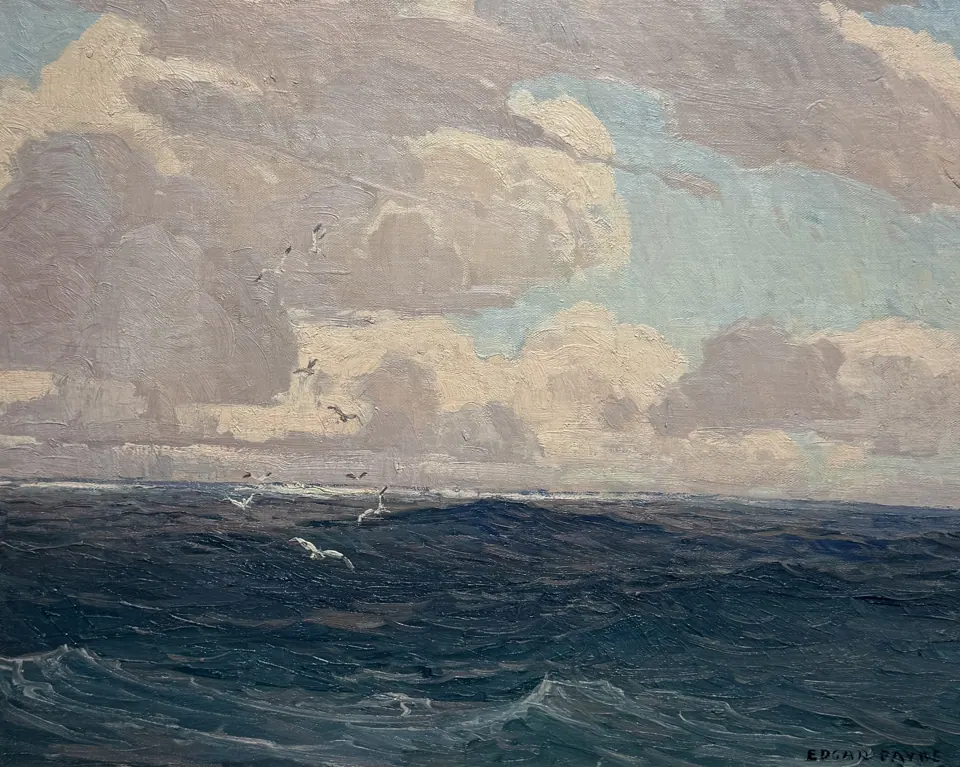
Payne's Laguna pictures, rocky coves, crashing surf, eucalyptus and the hills above the town, are among the most sought-after California coastal paintings. They show the broad, confident brushwork and high-keyed color of California Impressionism, but always with the strong underlying design that set Payne apart.
The High Sierra
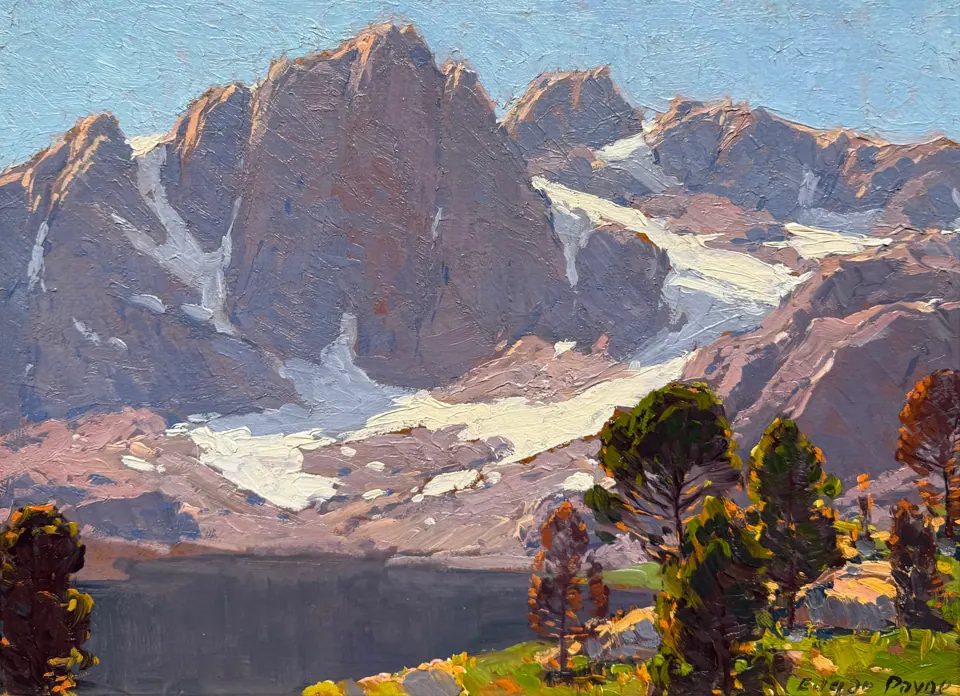
If one subject defines Edgar Payne, it is the Sierra Nevada. He returned to the high country again and again over a period of some three decades, packing into the mountains with mules and camping for weeks at a time so he could paint the peaks, granite ridges, glacial lakes and storm-swept skies directly from nature. Many of his finest canvases were developed in the studio from oil sketches and studies made on these trips.
Payne's Sierra paintings are recognizable for their monumental composition: massive peaks set against clouds, a foreground of boulders, twisted pines or a lake, and a deliberate rhythm of light and shadow that leads the eye into the picture. He painted with a loaded brush and directional strokes that describe the planes of rock. Works such as Sierra Majesty and Peaks at Noonday show the clarity of high-altitude light that he made his own.
The Southwest and Canyon de Chelly
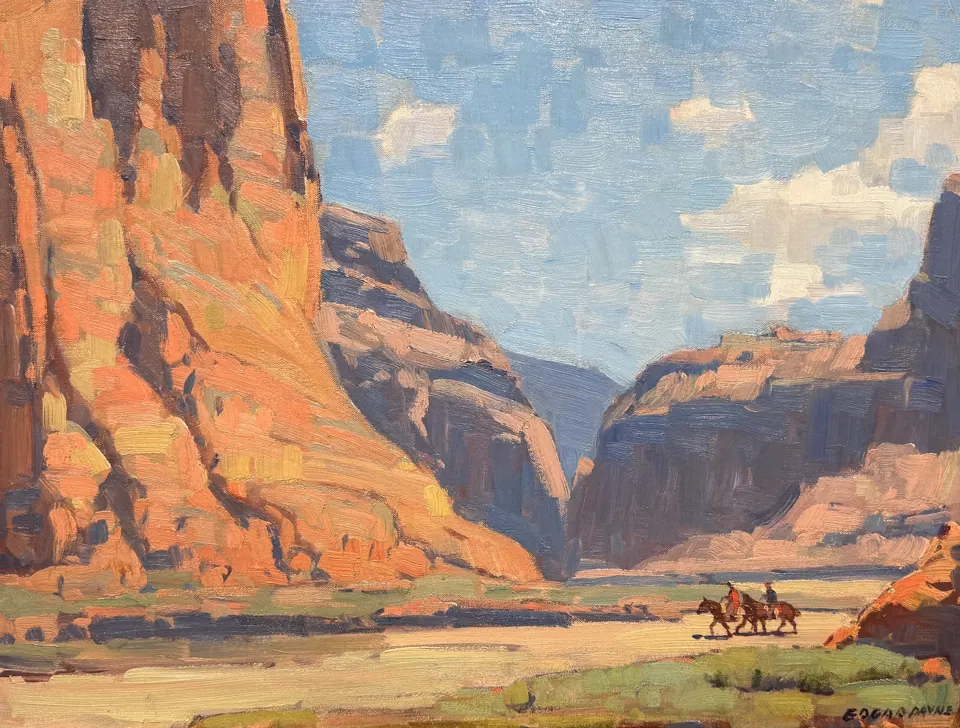
Payne also travelled repeatedly to Arizona, New Mexico and Utah. He painted the Grand Canyon, the red rock and mesa country, and above all the canyons of the Navajo (Diné) Nation in northeastern Arizona. In Canyon de Chelly he found a subject that combined his love of towering rock with the human element: Navajo riders on horseback moving beneath the sheer sandstone walls.
These Navajo rider and Canyon de Chelly paintings are among Payne's most celebrated and most collected works. The small figures give scale to the cliffs, and the warm reds and violets of the canyon walls contrast with cool shadows and pale skies. Collectors of Western American art prize them as much as collectors of California painting do.
Europe: Brittany boats, Italy and the Alps
From 1922 to 1924 the Payne family lived and travelled in Europe. Edgar painted in France, Switzerland and Italy, and the trip produced some of the most distinctive pictures of his career. In the Swiss and French Alps he painted the great peaks, among them the Matterhorn and the Wetterhorn, in the same monumental manner as his Sierra work. In 1923 he received an honorable mention at the Paris Salon.
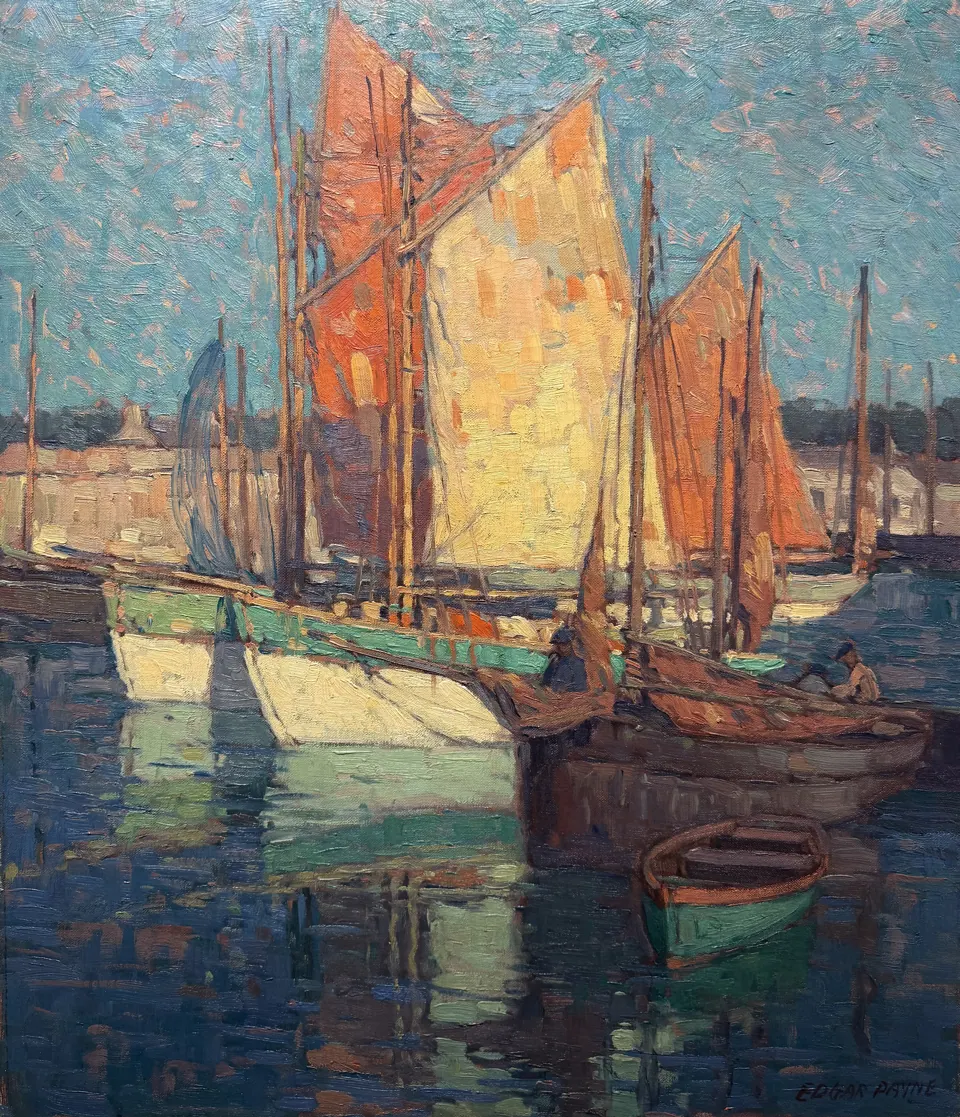
In the harbors of Brittany, at Concarneau, Douarnenez and other fishing ports, and at Chioggia near Venice, he painted the working fishing and tuna boats with their tall masts and red, orange and ochre sails. These boat paintings became a lifelong theme; Payne continued to paint boats from his European studies for years after his return. Their bold color, patterned sails and reflections on the water make them some of his most decorative and desirable works.
Later years and "Composition of Outdoor Painting"
After returning to the United States, Payne spent time in Chicago and New York before settling again in Southern California, where he lived in the Los Angeles area for the rest of his life. He continued to exhibit widely and was a member of organizations including the California Art Club and the Salmagundi Club in New York. Through the Depression years he kept painting the Sierra, the desert and the coast, and continued his boat subjects.
In 1941 Payne published Composition of Outdoor Painting, an instructional book that set out his ideas about design, the arrangement of masses, values, color and the use of standard compositional forms in landscape. It has been reprinted many times and is still studied by plein-air and landscape painters today, which is one reason Payne's name remains well known to artists as well as collectors.
Edgar Payne died in Los Angeles on April 8, 1947. Elsie Palmer Payne worked to keep his reputation alive after his death. His paintings are held today by museums including the Laguna Art Museum and the Smithsonian American Art Museum, and by many collections of California and Western art.
Collector's guide: what affects the value of an Edgar Payne painting
There is no single price for "an Edgar Payne." Values range widely, and the same artist can produce a modest sketch and a major museum-quality canvas. When we evaluate a Payne for a buyer or a seller, these are the factors that matter most:
- Subject. Major Sierra scenes, Canyon de Chelly and Navajo rider paintings, Brittany and Chioggia boats, and Laguna coastal views are generally the most sought-after. Quieter or more generic landscapes usually bring less.
- Size and medium. Large oils on canvas are typically worth more than small oil sketches on board, though a strong small panel can outperform a weak large canvas. Works on paper are a separate, generally lower market.
- Quality and period. Payne's best work of the late 1910s and the 1920s, with strong design and fresh color, attracts the most competition. Later paintings vary more in quality.
- Condition. Original canvas versus relining, paint loss, abrasion, old varnish and past restoration all affect value. Some condition issues are easy to correct; others are not.
- Provenance and exhibition history. A documented history, gallery labels, exhibition records or descent in the artist's family adds confidence and value.
- Frame. A fine period frame adds to the appeal of a painting, and replacing a good original frame can detract from it.
- Market timing and route. Whether a painting is sold at auction, privately or on consignment affects both the net result and how quickly you are paid.
Auction results are a useful guide, but they are easily misread without knowing the condition, quality and buyer's premium behind each figure. A free evaluation from a specialist is the most reliable way to understand what your painting is worth today. Request an evaluation.
How to authenticate an Edgar Payne
Paintings attributed to Payne do sometimes turn out to be by students, followers or other artists, and his signature has been imitated. Authentication should always be done by someone who has examined many genuine examples. Points that specialists look at include:
- The signature. Payne usually signed "Edgar Payne" in paint, most often in a lower corner. Its character, placement and whether it sits naturally in the paint layer are all examined.
- Technique and composition. Payne's work has a recognizable structure: clearly organized masses, deliberate value patterns and confident, directional brushstrokes. A painting that lacks this design sense deserves careful scrutiny.
- The back of the painting. Canvas, stretcher, panel, inscriptions, titles, exhibition and gallery labels, and framer's marks can confirm a date and history, or reveal problems.
- Documentation. Bills of sale, letters, old photographs and family history help establish provenance.
- Condition examination. Ultraviolet light can show retouching, overpaint or a signature added later.
Steven Stern has examined Edgar Payne paintings for 31 years. If you are unsure about a painting, send us photographs of the front, the back and the signature, and we will tell you what we think. Our other Payne site, edgarpaynefineart.com, and our gallery site CaliforniaPaintings.com show many more examples of his work.